How Often Should Solar Panels Be Cleaned in Plumas Lake, CA?
Discover optimal cleaning schedules for solar panels in Plumas Lake based on local conditions and buildup factors.
Solar panels are designed to sit outside year-round, but that does not mean they stay clean on their own.
In Plumas Lake, panels can collect dust, pollen, bird droppings, insects, leaves, and other airborne debris throughout the year. Long stretches of dry weather can allow that buildup to remain on the surface for months at a time.
So how often should solar panels actually be cleaned?
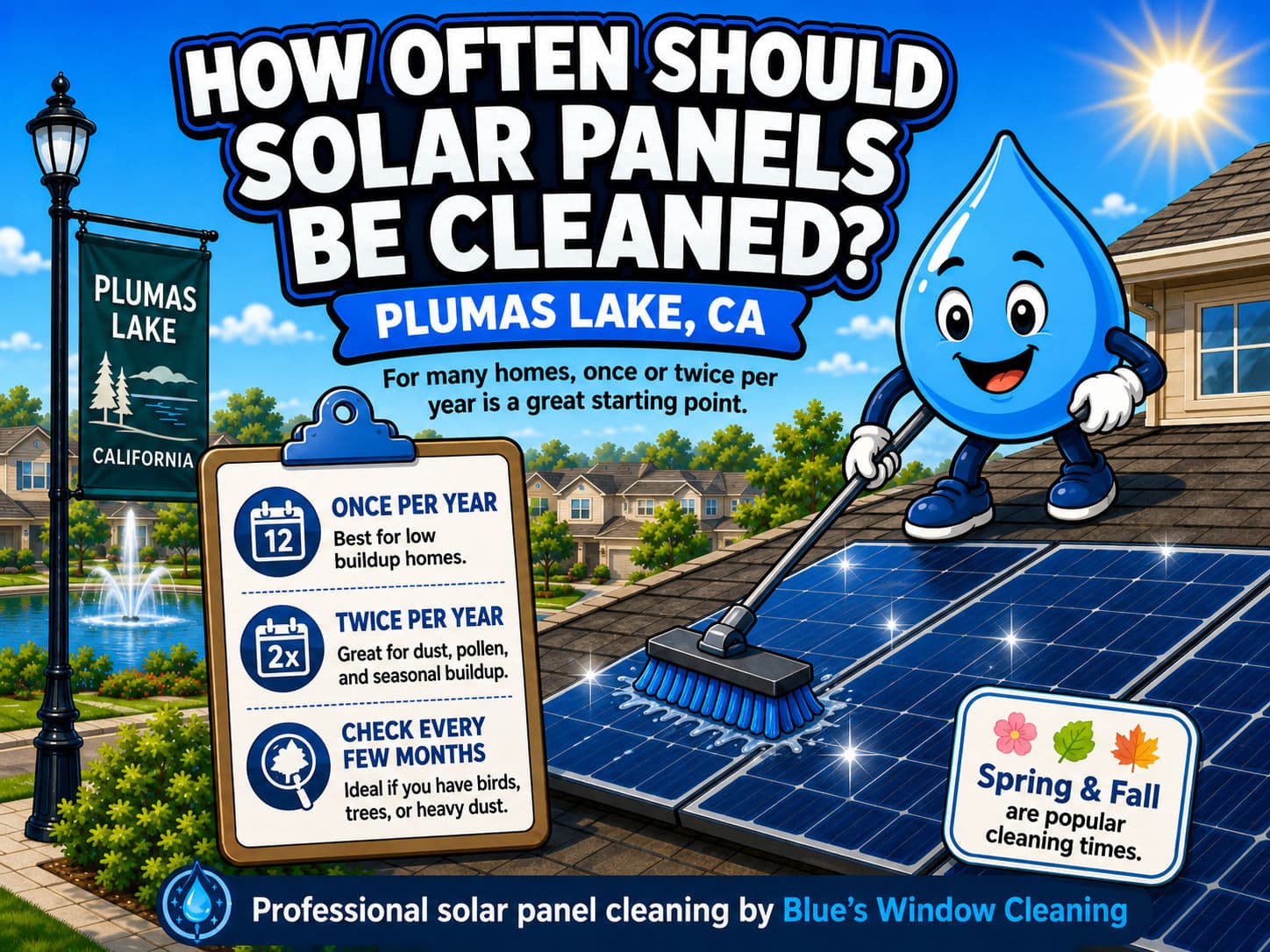
For many Plumas Lake homeowners, once or twice per year is a good starting point, although some properties may benefit from more frequent cleaning depending on their surroundings.
Blue’s Window Cleaning provides professional solar panel cleaning throughout Plumas Lake, California using purified water and soft, nonabrasive brushes.
How Often Do Solar Panels Need Cleaning?
There is no single schedule that works for every home.
A homeowner with panels on an open roof and little bird activity may be able to go much longer between cleanings than someone with panels near trees, agricultural activity, construction, or heavy bird traffic.
A practical schedule may look like:
Once per year for relatively clean systems
Twice per year for homes with noticeable seasonal buildup
More frequently when panels experience heavy dust, birds, trees, or other contamination
The best approach is to monitor the condition of the panels rather than relying only on the calendar.
Why Solar Panels Get Dirty in Plumas Lake
Plumas Lake has long periods of warm, dry weather, which can allow dust and debris to accumulate on rooftops.
Common sources of solar panel buildup include:
Dust
Pollen
Bird droppings
Insects
Leaves
Nearby landscaping
Road dust
Construction debris
Agricultural activity
Smoke or ash residue
Even a relatively thin layer of dust can make panels look dull, while bird droppings and heavier debris may remain stuck to the surface until physically cleaned.
Is Once a Year Enough?
For some homes, yes.
If your panels remain fairly clean and do not experience much bird activity or heavy dust, an annual cleaning may be enough to remove accumulated buildup.
Many homeowners prefer to schedule an annual cleaning before or during the sunnier part of the year.
However, if you can clearly see dirt or bird droppings on the panels several months after cleaning, waiting a full year may not make sense for your property.
When Twice-Yearly Cleaning Makes Sense
Twice-yearly solar panel cleaning can be a good option for homes that experience more consistent buildup.
A common approach is to clean:
Once in spring or early summer
and again
Later in summer or fall
The first cleaning can remove winter and spring buildup, while the second can remove dust and debris accumulated during months of dry weather.
This schedule can be especially useful for homes near:
Open fields
Busy roads
Construction
Trees
Areas with frequent bird activity
When Solar Panels May Need More Frequent Cleaning
Some solar systems get dirty much faster than others.
You may want to inspect or clean your panels more frequently if you notice:
Heavy bird droppings
Large amounts of dust
Leaves collecting around the panels
Nearby tree pollen
Construction dust
Visible ash or smoke residue
Debris collecting along panel edges
Panels that quickly look dull after cleaning
The condition of the panels should ultimately determine the schedule.
Does Rain Clean Solar Panels?
Rain can help rinse away some loose dust, but it does not necessarily provide a complete cleaning.
Think about a car windshield after it rains. The glass may look cleaner, but dirt, spots, and residue often remain.
Solar panels can behave similarly.
Rain may not completely remove:
Bird droppings
Pollen
Sticky debris
Insect residue
Dirt along panel edges
Heavier dust accumulation
Rain also does not provide the agitation that a professional soft-brush cleaning does.
What About Plumas Lake Summers?
Dry summer weather can be one of the biggest reasons panels accumulate visible dust.
When there is little rainfall, airborne dirt can continuously settle onto the surface without being rinsed away.
If your panels were cleaned in spring, it may be worth checking them again later in the summer to see how much buildup has accumulated.
Homes near open land, agricultural areas, or construction may notice this faster than other properties.
Bird Droppings Can Change Your Cleaning Schedule
Bird droppings are different from ordinary dust.
Dust may accumulate gradually across the entire system, while bird droppings create concentrated spots on individual panels.
They can also bake onto the surface during hot weather and become more difficult to remove over time.
If birds regularly sit on your roof, nearby power lines, or roof peaks, you may need to clean your panels more often than a home with little bird activity.
Should Solar Panels Be Cleaned Before Summer?
Spring and early summer are popular times to have solar panels cleaned.
This can remove:
Winter dirt
Spring pollen
Bird droppings
Dust
General outdoor buildup
Cleaning before the driest months also gives homeowners a clean starting point for monitoring how quickly the panels become dirty during summer.
Should Solar Panels Be Cleaned in Fall?
Fall can also be a good time for solar panel cleaning.
After months of dry weather, panels may have accumulated significant dust and outdoor debris.
A fall cleaning can remove that buildup before winter weather arrives.
For homeowners who clean twice per year, spring and fall can create a simple recurring schedule.
What If My Panels Look Clean?
If the panels still look clean, you may not need to schedule service simply because a certain number of months have passed.
Solar panel cleaning should be based on actual conditions.
You can visually inspect the system from the ground when possible and look for:
A dusty film
Bird droppings
Leaves
Heavy dirt
Uneven buildup
Debris around panel edges
Avoid climbing onto the roof just to inspect the panels.
Can Dirty Solar Panels Affect Performance?
Solar panels depend on sunlight reaching their surface.
Dust, bird droppings, and other debris can interfere with that exposure.
The actual effect varies based on the amount and type of buildup, weather conditions, panel angle, system design, and other factors.
Professional cleaning does not guarantee a specific increase in solar production, but it does remove surface contamination and restore a cleaner path for sunlight to reach the panels.
Why Professional Cleaning Instead of DIY?
Cleaning solar panels may seem simple, but roof access can make it dangerous.
This is especially true for:
Two-story homes
Steep roofs
Wet roofing surfaces
Difficult panel layouts
Panels close to roof edges
There is also a risk of using inappropriate tools or cleaning methods.
Professional solar panel cleaning allows the work to be completed using proper equipment without homeowners needing to climb onto the roof themselves.
How Blue’s Cleans Solar Panels
Blue’s Window Cleaning uses a purified-water system and soft, nonabrasive brushes.
Our process typically includes:
Inspecting the panels and access conditions
Rinsing away loose debris
Gently agitating the surface with a soft brush
Removing dust, pollen, and bird droppings
Rinsing thoroughly with purified water
Allowing the panels to dry naturally
We do not use high-pressure washing on solar panels.
Why Purified Water Matters
Ordinary tap water contains dissolved minerals.
When tap water dries on a surface, those minerals can remain behind as visible spots.
Our purification system removes most of those dissolved minerals before the water reaches the panels.
That allows the panels to dry with much less mineral residue than ordinary hose water.
A Simple Solar Panel Cleaning Schedule
For many Plumas Lake homeowners, this is a practical starting point:
Low Buildup
Clean once per year
Best for homes with minimal dust, bird activity, and nearby debris.
Moderate Buildup
Clean twice per year
Good for panels that noticeably accumulate dirt during spring and summer.
Heavy Buildup
Inspect every few months and clean as needed
May be appropriate for homes with heavy bird activity, nearby construction, trees, or substantial dust exposure.
Your actual schedule should be adjusted based on what you see on the panels.
Can Solar Panel Cleaning Be Bundled With Window Cleaning?
Yes.
Many Plumas Lake homeowners schedule solar panel cleaning and exterior window cleaning during the same visit.
Both services use professional purified-water equipment, making them a natural combination.
Bundling the services can also make it easier to take care of multiple exterior maintenance tasks at once.
How Much Does Solar Panel Cleaning Cost?
Blue’s Window Cleaning generally prices solar cleaning based on the number of panels and roof height.
Our standard pricing is typically:
$15 per panel for first-story systems
$20 per panel for second-story systems
Access, roof layout, and unusual conditions may affect the final estimate.
Signs It May Be Time to Schedule Solar Panel Cleaning
Consider having your panels cleaned if:
They are visibly covered in dust
Bird droppings are accumulating
It has been many months since the last cleaning
The panels have gone through a long dry season
Nearby construction has created additional dust
The surface appears dull or dirty from the ground
You recently purchased a home and do not know when the panels were last cleaned
You do not necessarily need to wait until the panels are extremely dirty.
Regular maintenance can prevent heavy buildup from accumulating in the first place.
Solar Panel Cleaning in Plumas Lake, CA
Blue’s Window Cleaning provides professional solar panel cleaning throughout Plumas Lake and the surrounding Yuba-Sutter area.
We use:
Purified water
Soft, nonabrasive brushes
Professional solar cleaning equipment
Controlled water flow
First and second-story access methods
Whether your panels need annual maintenance or more frequent cleaning, we can help determine a schedule based on the condition of your system.
Request a Solar Panel Cleaning Estimate in Plumas Lake
If you're unsure whether your solar panels are due for cleaning, take a look at them from the ground or send us a photo.
Blue’s Window Cleaning can help you determine whether the panels are ready for service and provide an estimate based on the panel count and roof height.
Contact Blue’s Window Cleaning today to request professional solar panel cleaning in Plumas Lake, California.